The Topkapi Palace was the official and primary residence in the city of the Ottoman Sultans for 400 years of their 600-year reign, from 1465 to 1853.

Initial construction began in 1459, ordered by Sultan Mehmed II, the conqueror of Byzantine Constantinople. The palace is a complex made up of four main courtyards and many smaller buildings.

The Gate of Felicity is the entrance into the Inner Court. The Sultan used this gate and the Divan Meydam square only for special ceremonies. The Sultan sat before the gate on his Bayram throne on religious, festive days and accession, when the subjects and officials perform their homage standing.


The Neo-classical Enderûn Library (Enderûn Kütüphanesi), also known as "Library of Sultan Ahmed III" (
III. Ahmed Kütüphanesi), is situated directly behind the Audience Chamber (Arz Odası) in the centre of the Third Court.

Details inside the palace.

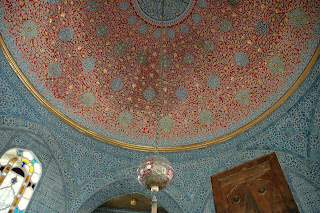
The Imperial Council (Dîvân-ı Hümâyûn) building is the chamber in which the ministers of state, council ministers (Dîvân Heyeti), the Imperial Council, consisting of the Grand Vizier (Paşa Kapısı), viziers, and other leading officials of the Ottoman state, held meetings. It is also called Kubbealtı, which means "under the dome", in reference to the dome in the council main hall. It is situated in the northwestern corner of the courtyard next to the Gate of Felicity.


 Initial construction began in 1459, ordered by Sultan Mehmed II, the conqueror of Byzantine Constantinople. The palace is a complex made up of four main courtyards and many smaller buildings.
 The Gate of Felicity is the entrance into the Inner Court. The Sultan used this gate and the Divan Meydam square only for special ceremonies. The Sultan sat before the gate on his Bayram throne on religious, festive days and accession, when the subjects and officials perform their homage standing.
 The Neo-classical Enderûn Library (Enderûn Kütüphanesi), also known as "Library of Sultan Ahmed III" (III. Ahmed Kütüphanesi), is situated directly behind the Audience Chamber (Arz Odası) in the centre of the Third Court.
 Details inside the palace.
 The Imperial Council (Dîvân-ı Hümâyûn) building is the chamber in which the ministers of state, council ministers (Dîvân Heyeti), the Imperial Council, consisting of the Grand Vizier (Paşa Kapısı), viziers, and other leading officials of the Ottoman state, held meetings. It is also called Kubbealtı, which means "under the dome", in reference to the dome in the council main hall. It is situated in the northwestern corner of the courtyard next to the Gate of Felicity.
 The tower was repaired by the turkish architect Murad Bin Hayreddin in 1510. During the reign of Murat IV (1612-1640).
 The tower's altitude is 61 meters. You can go up and you can enjoy see all the architectural beauties of Istanbul.


